


Getting to the bottom of what organizational and personal purpose really are — and what they can do for your enterprise.
If there is any question whether stakeholder capitalism is evolving and that organization purpose is playing an increasingly pivotal role, one need look no further than the recent declaration by Larry Fink, CEO of BlackRock, the world’s largest asset manager, that “Without a sense of purpose, either public or private, no company can achieve its full potential.”
In broad strokes, successfully deploying a purpose-driven strategy requires four steps:
1. Developing a stated purpose that uniquely and deeply commits at the point where your stakeholder values and interests converge. This most often requires:
- Consideration for customers, employees, shareholders, partners, and communities.
- Greater specific insight into these values and interests than likely prevails at the outset
- Explicitly leveraging at least some of your organization’s distinctive strengths in new ways.
- Adeptly balancing noble aspiration with what’s achievable in a reasonable timeframe
- Ensuring active Board alignment and “ownership”
2. Architecting the most essential requirements for deployment success, including:
- Mapping new or different value drivers
- Prioritizing the most important implications for product portfolio and organizational systems
- Identifying actions needed by leadership to “make it real”
3. Mobilizing meaningful action that affirms intent and inspires conviction, including:
- Commencing or accelerating critical path initiatives
- Fostering specific behavior changes for individuals or groups that have early, leading impact
- Communicating and engaging day to day focus
4. Steadily growing value and contribution over time, including:
- Measuring and rigorously evaluating progress
- Addressing misalignments (e.g., outdated incentive systems) that remain
- Aiming higher over time
Organizational purpose
Before doing anything else however, it’s important for you and your team to understand the myths and realities of organization purpose. As the number of organizations that are undertaking purpose initiatives increases, so does the volume of perspectives – and misperceptions – on what organizational purpose is, what it requires, and what can result. It behooves us, then, to sort fiction from fact. And, since connecting personal purpose to organizational purpose is the critical “final mile” of successful purpose-driven companies, it’s important to understand myths and realities of personal purpose as well.
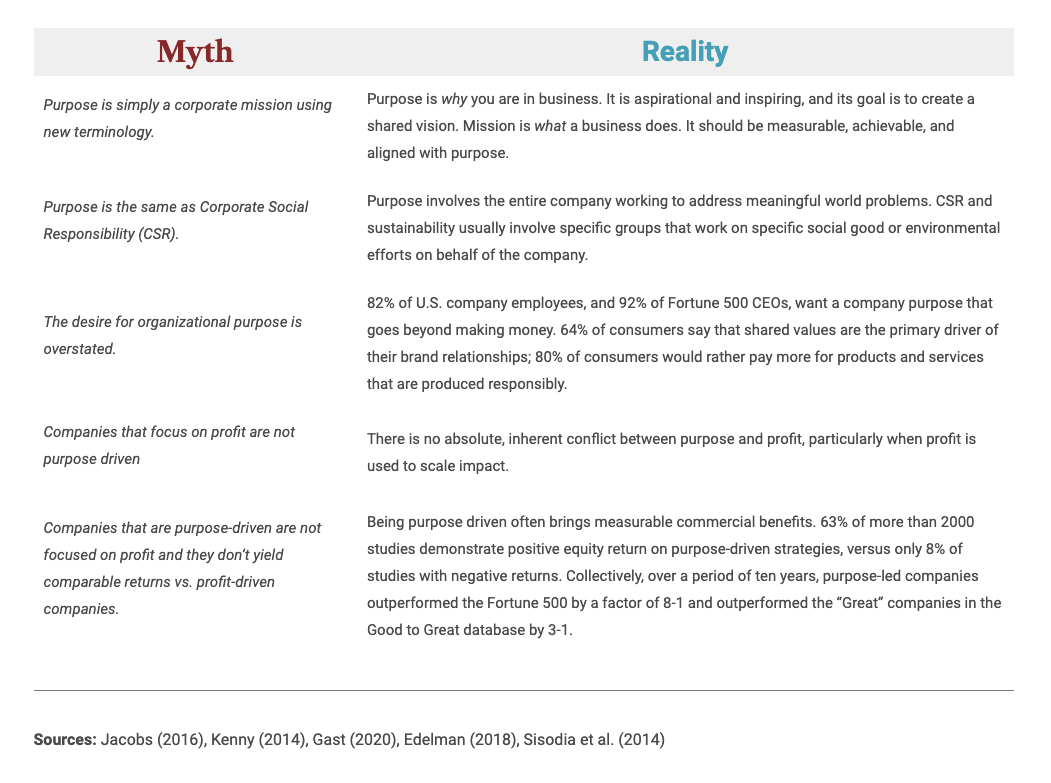
For this reason, we have synthesized and supplemented relevant research and articles on common beliefs about purpose. The table below elaborates.
Taken together, the myths concerning organizational purpose appear to be rooted in the view that organizations can either make money or do good, but not both. The evidence increasingly suggests that, for skillful, determined companies, the “and” is both possible and highly desirable.
Personal purpose
In contrast, myths about personal purpose tend to be rooted in a fixed mindset.
In short, the reality of personal purpose is more consistent with a growth mindset that is accompanied by flexibility, judgment, and development over time, than it is with a fixed, unchanging view. “Discovering” personal purpose is about designing, not finding.

The direction is clear
Potential advantages of competing with purpose are real, substantial, and achievable. And the benefits across your range of stakeholders can be materially significant and deeply meaningful.
To make the most of purpose, however, it helps to ground your efforts in a shared understanding of what’s supported, and what isn’t, by evidence and experience.
