“What’s the best team experience you’ve ever had?” It’s a deceptively simple question with potentially significant implications for you and your team.
In our work with senior teams over two decades, we have had the opportunity to ask this question of scores of teams and several hundred leaders. What we’ve observed is illuminating and perhaps a bit surprising.
First, nearly everyone has at least one favorite team experience that they quickly recall. The examples are varied and poignant: Winning the province choir competition after four years of disappointment, designing and building a neighborhood recreation center with the very people who once opposed the project, losing the State basketball championship to the perennial powerhouse, but surprising everyone with their small-but-mighty performance against all odds, and so on. One in five examples draw upon a workplace experience, usually from early career and often involving turnarounds or start ups. But rarely – very rarely – do senior teams mention their current team.
Second, they don’t just come up with their examples, they light up with them. Similar to asking “Who is the best teacher you ever had?,” the topic of best team experience summons emotional sharing and, yes, even keen listening. People see some of themselves in others’ stories, see something in their peers that enhances affinity, and generally enjoy the discussion to the point that it’s often a struggle to move on to the day’s agenda.
Third, though the examples are quite different from one another, the elements across the best team experiences are quite similar…
- The circumstances usually involve challenges and adversity. Success was uncertain and many outside the team doubted that success was even possible.
- The outcomes speak to deep, enduring pride in prevailing against the odds, and accomplishing what others said could not be done. And, though “winning it all’ is certainly a feature of some stories, the more prevalent theme is about the victory of exceptional achievement by personal standards. In many cases, execs share that “we weren’t the best or most talented, but we found a way to be extraordinary anyway.”
- The key team ingredients that led to these experiences are more numerous and involve themes such as seeing the possibility in the challenge, facing a mountain to climb, feeling unified in the quest, every member having a special contribution to make that is understood by all, and so on.
Once a senior team has completed its list of these common themes, we ask the natural question, “Which of these elements could we build into this team, if we chose to?” You’re to be forgiven if you would expect this question to be met with cynicism or worse. But that’s not what typically happens. The predominant response is, “Nearly all of them.” The majority of senior teams review the list in earnest, strike one or two items and, a bit to their surprise, retain the rest.
This reflection prompts, of course, one more question. “If it’s possible to create one of the best team experiences of our careers, one that rivals the meaningful memories that we may carry for our lifetime, why aren’t we doing it?” The answer is nearly always the same: We never thought about it. Not, “Our situation is too different,” not “we’re too busy,” not “It’s survival of the fittest here.” None of that. Simply, “we never thought about it.
What if we thought about it?
Suppose that your team did think about it. What if your team members consciously chose to improve their team experience in a way that accomplished the exceptional and built enduring pride? What steps might you take? True performance excellence for top teams, as with most areas of performance excellence, ultimately requires specific methods and expertise that go beyond the scope of this brief article. That said, there are simple steps that you can take to get started.
1. Translate common themes into useful criteria.
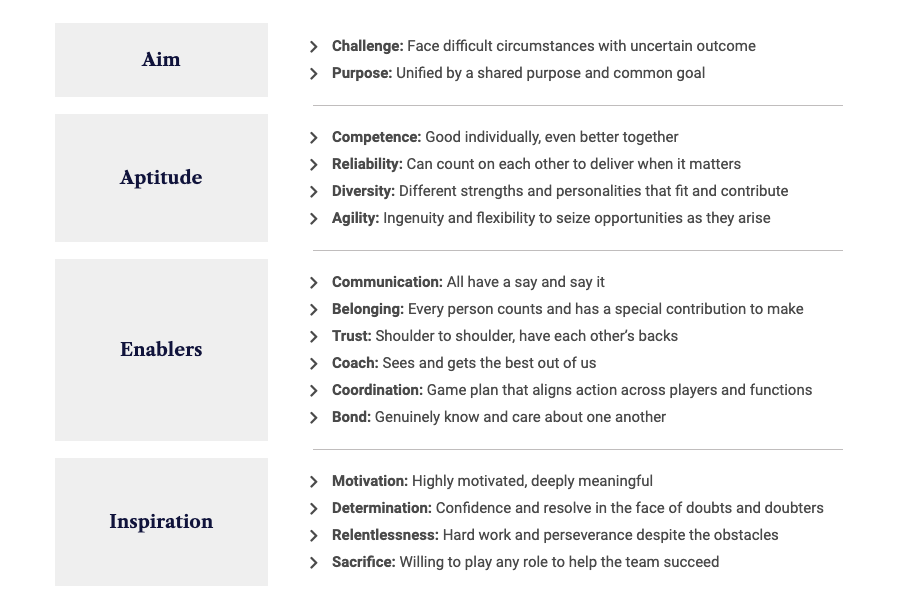
Before the resonance of the discussion fades, shape the list of elements into a succinct set of attributes that can serve both as a reminder and as a way to track progress (or lost ground) over time. The attributes usually group into four categories: aim, aptitude, enablers, and inspiration. As well, common attributes that the senior teams identify include the following.
2. Confirm your baseline
Though you may very well want a more complete and quantitative baseline of team strengths and gaps subsequently, you can use this list of attributes as a starting point. Teams can usually agree on red/yellow/green current snapshot ratings for each listed attribute quickly and productively. Don’t be surprised if the snapshot reflects ample room for improvement. Remember, the attributes originated with a “best team experience” discussion. The typical profile at the outset is 50% red, 40% yellow, 10% green (with the most common green attribute being “Working hard and persevering…”) Despite this, teams are generally motivated by the opportunity that they have just created to improve something in a meaningful way, and certainly are not surprised by their starting point.
3. Pick one thing that the team wants to improve first, and set your target time frame accordingly.
For instance, teams will often set a target of shifting the color from red to yellow or yellow to green on one attribute within three months, and then a handful of others within six months. Communication, coordination, and trust are often the first improvement areas that teams target. For better or for worse, “genuinely knowing and caring about one another” is usually the attribute that is deemed most difficult and requiring the longest period of time to improve.
4. Clarify what the improvement will look like and what it will take.
Pinpoint specifically what the targeted improvements will look like in terms of specific actions, and ensure that team members are clear and committed to the behavior changes, large or small, that are implied. For instance, it’s one thing for a team to agree to a communication principle, “If in doubt, reach out.” It’s even more useful to pinpoint the specific behavior that the principle requires, e.g., asking each member to confirm what types of communication are most important to them, and what forms of communication (e.g., email vs voice to voice) work best for them. As well, since replacing old habits with new ones is rarely a flawless process, it helps if team members agree on how they will handle inevitable “slippage.”
5. Check in regularly.
Build brief progress reviews into team meetings and one on one conversations. Most importantly, use this as an opportunity to provide feedback, coaching and encouragement. Make it count and, whenever possible, make it fun.
Inspiring commitment
Asking, “What’s the best team experience you’ve ever had?” initiates a dialogue – a heartfelt, engaging dialogue – that often leads to an unexpected commitment to get better at the very things that will help your team elevate its own functioning. The steps that follow aren’t quite that easy, of course. But, the discussion establishes a positive (and often novel) shared experience that resets the context for what can be accomplished together.