


The best teams are more than just a sum of their parts.
Suppose that by developing just a few of your top team’s capabilities, you could reliably elevate your team’s performance across a broad range of high impact responsibilities? What if these same factors could elevate the performance of any – or every – team in your organization? Emerging research on “collective intelligence” suggests that it’s possible.
To be clear, when we refer to collective intelligence, we are talking about the interdependent performance of leadership teams as a whole, rather than what individual team members accomplish when they are working and leading independently. Deepening our understanding of reliable performance drivers of the senior team as a whole is timely for a number of reasons. Elevating top team performance is:
- Important. It impacts the organization in significant ways. As the senior team goes, so goes the organization.
- Not easy. Bringing together accomplished individuals doesn’t naturally translate into a highly accomplished team. It takes work and many senior teams never get there.
- Different. We know intuitively that performing as a member of a group requires different skills than performing individually, but we don’t necessarily know precisely why or how.
- Less often addressed. “Leadership” is more often treated as an individual pursuit and is researched and developed as such.
Recent advances
For some years now, researchers have searched for a group equivalent to individual IQ. In other words, is there a set of measurable attributes that reliably predicts future group performance across a range of performance demands? Moreover, if collective intelligence does indeed exist, is it related to the IQ of individual group members, or is it something different altogether?
The collective intelligence work that has been conducted by Carnegie Mellon’s Dr. Anita Woolley and her colleagues holds particularly intriguing implications for senior teams. In a series of studies over the past decade, they have demonstrated that it is indeed possible to measure a set of factors that, together, clearly predict which groups will outperform others. Early indications are that:
- This is true for senior teams and Boards as well as a variety of other teams.
- Collective intelligence predicts performance a broad range of performance demands.
- Individual IQ of team members has very little to do with it. There is a marginal advantage of higher IQ amongst team members, but nothing more than that.
The “Basic Ingredients”
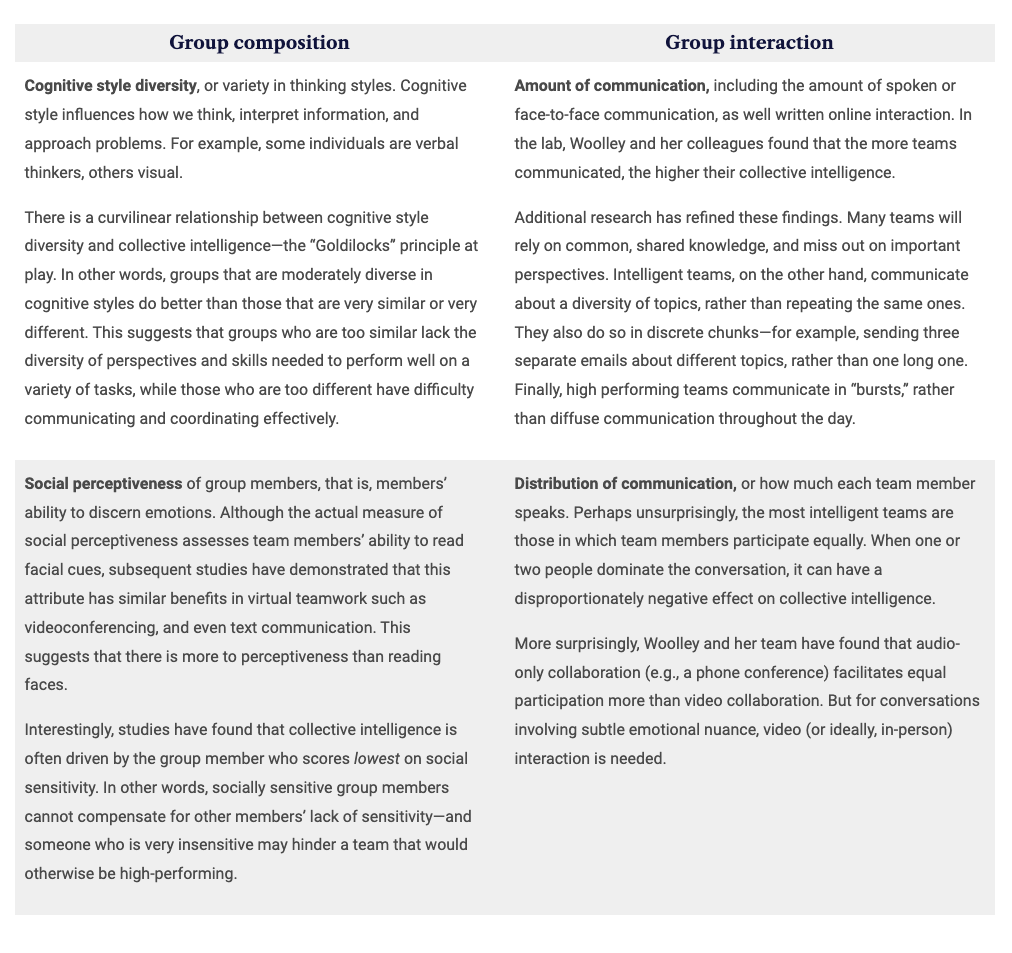
If IQ isn’t the source of collective intelligence, then what is? To date, Dr. Woolley and her colleagues have identified four main drivers of collective intelligence, which fall into two categories: group composition and group interaction.
Implications
While there is still much to learn, it’s not too soon to apply and experiment with the findings to date.
First, establish where the team stands today. Ideally, teams will use a combination of objective measures and qualitative ratings to determine where they fall on each of the four drivers. And ensuring that each team member receives their own personal baseline, in addition to the group profile, improves self-awareness and allows for more pinpointed improvement.
The “frequent communication” and “equal participation” drivers are behavioral, observable, and can begin to improve immediately with the right attention—making them a great place start. When it comes to communication, begin by focusing on frequency and amount, then move to communication quality and value.
The Four Drivers of Collective Intelligence
- Cognitive style diversity
- Social perceptiveness
- Amount of communication
- Distribution of communication
To improve participation, as a team, invest time in developing practical agreements and norms. How can you best help one another rebalance participation? Often, this is less about breaking existing habits, and more about transforming them into new ones. For instance, extroverts in the group don’t have to stifle their need to vocalize. But instead of just “thinking out loud”, they can actively bring others into the conversation. For example, by asking thoughtful questions, they can help their more introverted colleagues share their ideas and make their thought process transparent.
Teams can also avoid the trap of relying on common, shared knowledge. How? Teams must both 1) encourage members with diverse perspectives to speak up, and 2) encourage the group to take these contributions seriously. It all starts with a shift in mindset—be open to new information. When teams expect to encounter diverse opinions, they’re more likely to take them seriously.
Experiment with communicating in “bursts.” For example, select windows when team members will communicate—by phone, videoconference, email, etc.—and stick to those times, rather than communicating ad hoc throughout the day. And keep communicating focused on a specific topic, rather than on many different things at once.
While cognitive style diversity depends on who is on the team, and thus is often static, psychologists suggest that teams can reap the same benefits for creativity and performance by other means. Specifically, by understanding where each other’s relative strengths, weaknesses, and expertise lie. In other words, teams must ask themselves: what is the best way for us to relay information to each other about our relative skills? And how can we best give feedback and strategic suggestions about how to take advantage of those skills?
Finally, while more difficult, teams should identify when norms, patterns, behaviors are disruptive. While handling these issues is difficult, there’s scientific evidence that it’s necessary. Often, this work is made easier—or possible at all—with the help of an experienced coach.
First mover opportunity
For leaders who are simply interested in “what works,” the study of collective intelligence appears to be reaching this threshold. That said, for those leaders who want to contribute in breaking new ground and advancing leadership science, these are still early days and there is ample opportunity to make a difference.
- There is still a need to round out the understanding of collective intelligence drivers in the workplace.
- There are still unanswered questions regarding, for instance, the extent to which social perceptiveness can be enhanced in a top team environment, or why psychological safety has not emerged has a key driver of collective intelligence.
- Most importantly, there is still more to be learned about how best to deploy collective intelligence for new workplace advantage.
In sum, the recent work on collective intelligence has useful implications for top team performance and is “flying under the radar screen” of most organizations. It’s worth taking the time to take notice. The specificity and focus of the drivers likely has practical value. Baseline and progress metrics are available. And, while improvement almost certainly requires behavior change – which we all know is easier said than done – our experience is that teams often readily (and even enjoyably) achieve improvements when they commit to do so.
